Impulse on a Force-Time Graph (AQA A Level Physics): Revision Note
Exam code: 7408

Impulse on a force-time graph
In real life, forces are often not constant and will vary over time
If the force is plotted against time, the impulse is equal to the area under the force-time graph
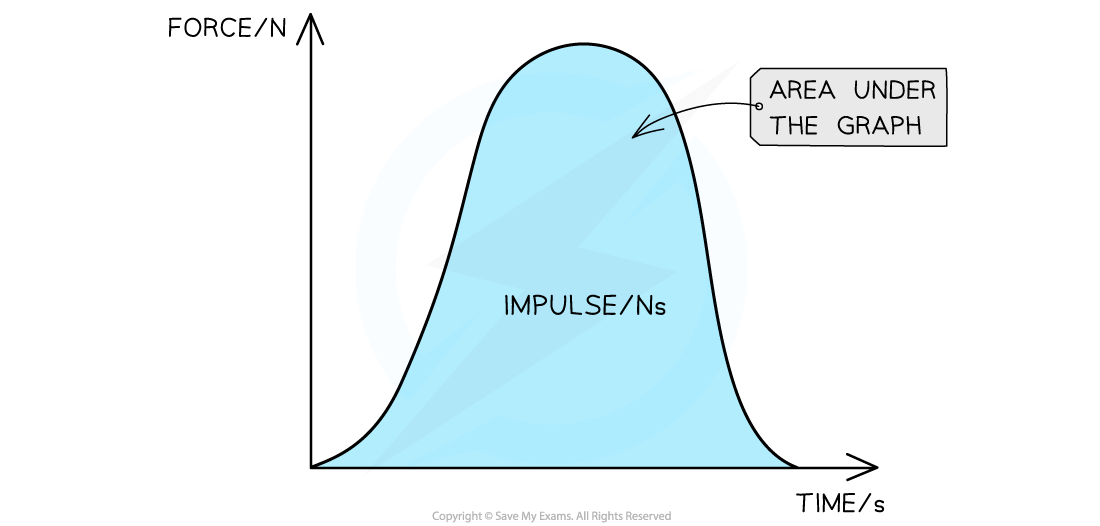
This is because
The impulse is therefore equal whether there is a small force over a long period of time or a large force over a small period of time
Since change in momentum is equal to impulse, the same change in momentum over a longer period of time will produce less force (and vice versa)
The force-time graph may be a curve or a straight line
If the graph is a curve, the area can be found by counting the squares underneath
If the graph is made up of straight lines, split the graph into sections
The total area is the sum of the areas of each section
Worked Example
A ball of mass 3.0 kg, initially at rest, is acted on by a force F which varies with t as shown by the graph.

Calculate the velocity of the ball after 16 s.
[3]
Answer:
Step 1: List the known quantities
Mass of ball, m = 3.0 kg
Initial velocity of ball, u = 0 m s-1 (since it is initially at rest)
Step 2: Calculate the impulse
The impulse is the area under the graph
The graph can be split up into two right-angled triangles with a base of 8 s and a height of 4 kN
[1 mark]
Step 3: Write the equation for impulse
Step 4: Substitute in the values
[1 mark]
[1 mark]
Examiner Tips and Tricks
Some maths tips for this section:
Rate of Change
‘Rate of change’ describes how one variable changes with respect to another
In maths, how fast something changes with time is represented as dividing by Δt (e.g. acceleration is the rate of change in velocity)
More specifically, Δt is used for finite and quantifiable changes such as the difference in time between two events
Areas
The area under a graph may be split up into different shapes, so make sure you’re comfortable with calculating the area of squares, rectangles, right-angled triangles and trapeziums!
Impact forces
Impact forces are reduced by increasing the contact time
This fact is used in everyday life to lower the risk of injury
Some examples of where reducing impact force is important:
in sport
in packaging
In sports
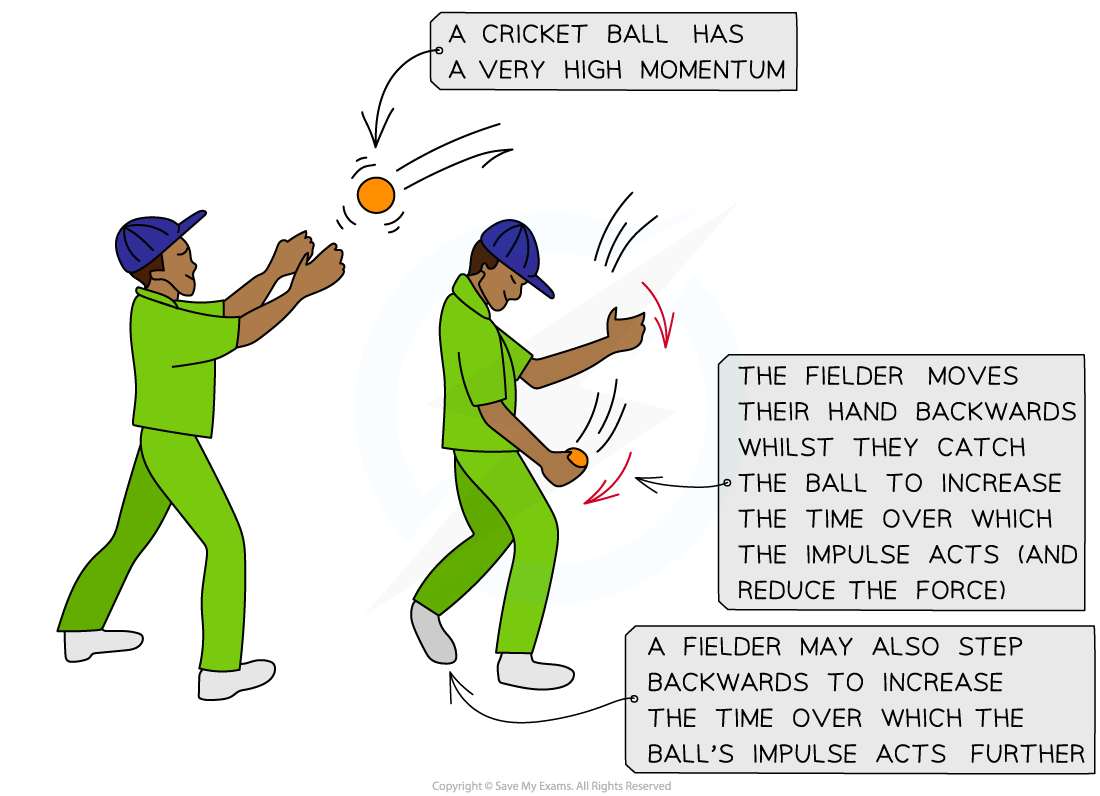
For example, in cricket, when a fielder relaxes their hands and pulls them back when catching a ball
A cricket ball travels at very high speeds and therefore has a high momentum
When a fielder catches the ball, it exerts a force onto their hands
Stopping a ball with high momentum instantly will cause a large force on their hands
This is because a change in momentum (impulse) acts over a short period of time which creates a large force on the fielder's hands and could cause serious injury
A fielder moves their hands back when they catch the ball, which increases the time for its change in momentum to reduce
This means there will be less force exerted on the fielder's hands and, therefore, less chance of injury
In football:
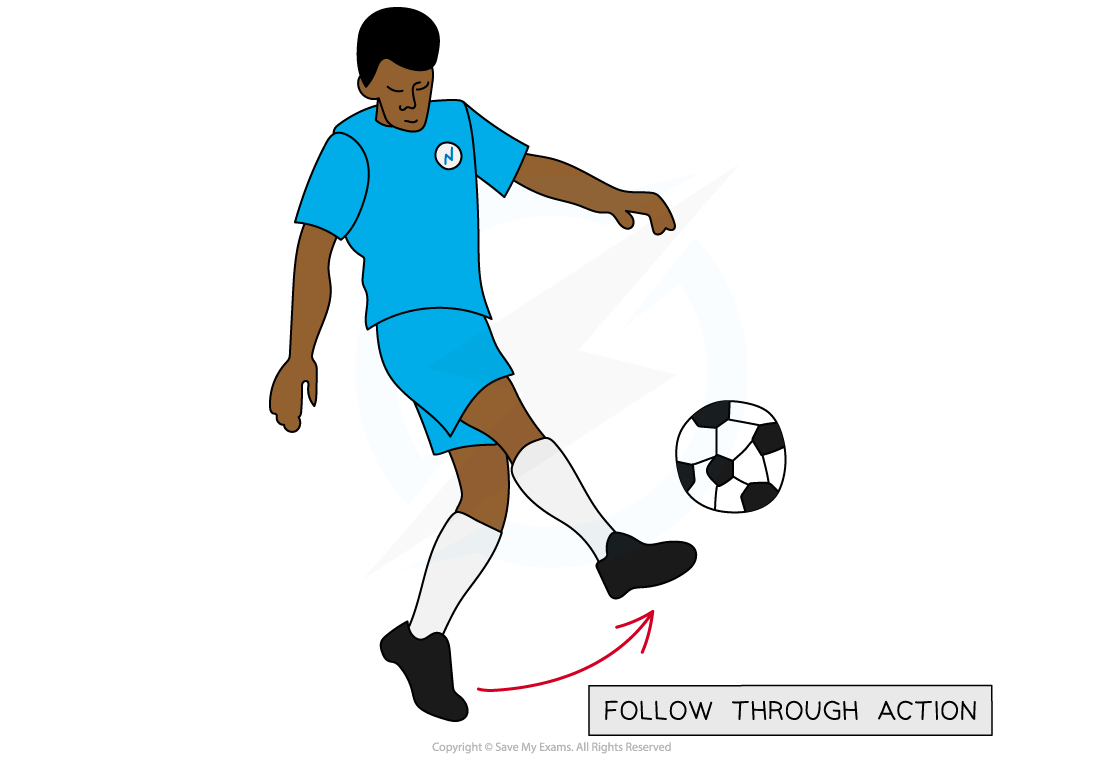
Increasing the contact time is sometimes used to advantage, as the longer the contact time, the larger change in momentum
When kicking a football, after a strong kick the motion is followed through
The momentum from the foot is transferred to the ball
This creates a large impulse and the ball then has a higher velocity
In packaging
Packaging, especially for fragile items, uses bubble wrap or polyester packaging to reduce the impact forces that items experience in transit
These help cushion the items by increasing the time over which they experience a force, which reduces the risk of damage
Worked Example
A tennis racket strikes a tennis ball two different times. On both strikes, the change in momentum of the tennis ball is 0.5 kg m s-1.
On the first strike, the racket is in contact with the ball for 2.0 s. On the second strike, the racket is in contact with the ball for 0.1 s.
Determine which strike delivers the greatest force on the ball.
[2]
Answer:
Step 1: List the known quantities
Change in momentum,
Contact time of first strike,
Contact time of second strike,
Step 2: Determine the force exerted on the ball by the first strike of the racket:
Step 3: Determine the force exerted on the ball by the second strike of the racket:
[1 mark]
Step 4: Conclusion
The second strike delivers the greatest force (5.0 N compared to 0.25 N) [1 mark]

Unlock more, it's free!
Join the 100,000+ Students that ❤️ Save My Exams
the (exam) results speak for themselves:

Was this revision note helpful?
Build on this topic