Trigonometry (DP IB Analysis & Approaches (AA): SL): Exam Questions

6 hours46 questions
1a
2 marks

A person requires rescuing from the top of a building at a height of 8.2 m. A fire truck has an extendable ladder with its fixed end at a height of 1.6 m. It has been parked at a horizontal distance of 3.7 m from the building, as shown in the diagram below.

q5a-3-1-hard-ib-ai-sl-maths

Calculate the length of the ladder required to reach the top of the building.

1b
2 marks

For safety purposes, the angle made between the ladder and the horizontal surface it stands on should be between 70° and 80°.

Show that the ladder on the fire truck, in this situation, would not be safe.

1c
2 marks

The fire truck is moved to a horizontal distance from the building that enables the optimal angle of 75° to be achieved.

Calculate the length that the ladder now has to be extended to.

2a
3 marks

The diagram below shows a cuboid ABCDEFGH measuring 45 cm × 72 cm × 112 cm.

q1a-3-2-medium-ib-aa-sl-maths

Find

(i) AF

(ii) BH

(iii) AC.

2b
2 marks

Find BG.

3a
2 marks

Nathan, N, stands on a balcony 10 m above the ground and can see Melissa, M, in the car park. The angle of elevation from Melissa to Nathan is 21.6°.

Find MN.

3b
3 marks

Louisa, L, is standing on the other side of the car park, where LN=1.5×MN.

Find the angle of depression from N to L.

1a
4 marks

Owen, Henry and Tom are rugby players passing a ball in a park. Owen is at point O, Henry is at point H and Tom is at point T, where OH=25 m, HT=18 m and OH^T=96°.

(i) Draw and label a diagram to represent this information.

(ii) Find OT.

1b
3 marks

Find OT^H.

1c
2 marks

The players pass the ball within triangle OHT.

Find the area of triangle OHT.

2a
3 marks

A sailing race takes place on a large lake. The competitors must sail around five buoys, at the points A, B, C, D and E, in a clockwise direction.

B is due east of A, C is due south of B and E is due south of A. The bearing of D from C is 220°. AB=1200 m, BC=600 m, CD=800 m and EA=1000 m.

Draw and label a diagram to show the buoys A, B, C, D and E, clearly marking the bearing and distances given above.

2b
2 marks

The boats start at A. A support boat can travel directly across the course from A to C and from A to D.

Find AC.

2c
4 marks

Find AD.

2d
4 marks

Find the bearing the support boat must follow to travel from A to D.

3a
2 marks

The following diagram shows triangle ABC, with AC=21 km, CB=15 km and AC^B=75°.

q3-3-3-medium-trigonometry-ib-maths-

Find the area of triangle ABC.

3b
3 marks

Find AB.

3c
3 marks

Given that CA^B is acute, find CA^B.

4a
1 mark

Triangle ABC has an area of 122 cm², where AB=24 cm and BC=11 cm.

Draw and label a diagram to show triangle ABC, clearly marking the distances given.

4b
6 marks

Given that AB^C is acute, find

(i) AB^C

(ii) AC.

5a
3 marks

The quadrilateral ABCD shown below represents a farm paddock, where AB=246 m, BC=312 m, AD=257 m, DA^B=96° and BC^D=78°.

q5-3-3-medium-trigonometry-ib-maths-

A fence is built from B to D to split the paddock into two parts.

Find the length of the fence, BD.

5b
6 marks

Find the area of the paddock ABCD.

6a
2 marks

A cliff 38 m high is perpendicular to the sea. The angle of depression from the top of the cliff to a boat at sea is 24°. A rock climber is partway up the cliff, and the angle of elevation from the boat to the climber is 14°.

Draw and label a diagram to show the top of the cliff, T, the foot of the cliff, F, the climber, C, and the boat, B, labelling all the angles and distances given above.

6b
2 marks

Find the distance from the boat to the foot of the cliff, BF.

6c
4 marks

Find how far the climber must climb to reach the top of the cliff, CT.

7a
3 marks

The following diagram shows triangle XYZ, with YZ=5.4 cm. The point W lies on [XZ], with XW=5.6 cm, WZ=4.2 cm and YW=5.8 cm.

q7-3-3-medium-trigonometry-ib-maths-

Find YZ^W.

7b
2 marks

Find the area of triangle XYZ.

7c
3 marks

Find the area of triangle XYW.

8a
2 marks

The distance between towns X and Y is 134.2 km, and the bearing of X from Y is 119°. Town Z is on a bearing of 207° from town X, and is 54 km further south than town X.

Draw and label a diagram to show towns X, Y and Z, clearly marking the bearings and distances given above.

8b
2 marks

Find XZ.

8c
4 marks

Find YZ.

9a
2 marks

ABCD is an isosceles trapezoid where AB=17 m and AD=BC=25 m, as shown in the diagram below.

q1a-3-1-medium-ib-ai-sl-maths

Find the height, h, of the trapezoid.

9b
4 marks

Find the area of the trapezoid.

10
3 marks

The distance between Ho Chi Minh City and Hong Kong is known to be 1500 km. The bearing of Hong Kong from Ho Chi Minh City is 046°. Another city, Brisbane, is 6500 km from Ho Chi Minh City on a bearing of 136°. Calculate the distance between Hong Kong and Brisbane.

11a
4 marks

The diagram below shows an architect’s drawing of the front view of a house. The house is in the shape of a rectangle with a height of 10.8 m and has a roof in the shape of a right-angled isosceles triangle, BCD, where BD=12.2 m and BC^D=90°. Next to the house is a garage in the shape of a rectangle measuring 4 m by 3.6 m, with a roof in the shape of a right-angled triangle, EFG, where GF=4 m and EF^G=37°.

q10a-3-1-medium-ib-ai-sl-maths

(i) Find EG.

(ii) Find BC.

11b
6 marks

Find the total area of the front view of the house.

12a
2 marks

A competitor is flying their kite in a competition. The kite is on a string of length 206 m and has an angle of elevation of 74° from the competitor, as shown in the diagram below.

q1a-3-1-hard-ib-ai-sl-maths

Calculate the vertical height, in metres, that the kite is flying at above the point the competitor is holding it.

12b
3 marks

A second competitor raises their kite to the same vertical height from the same position as the first competitor. The angle between the two kites is 13°, as shown in the diagram below.

q1b-3-1-hard-ib-ai-sl-maths

Calculate the length of the string for the kite flown by the second competitor.

13a
3 marks

A small airline operates between three locations A, B and C, in one particular country. B is located 530 km from A on a bearing of 248°. C is located 300 km due East from the midpoint, M, of [AB]. This information is shown in the diagram below.

q2a-3-1-hard-ib-ai-sl-maths

Calculate AC.

13b
4 marks

Calculate the bearing that an aeroplane would need to fly on if it were travelling from C to B.

14a
2 marks

A gymnast is competing in the women’s uneven bars event. The bars are held in place by vertical supports at points A and B, as shown in the diagram, where A and B are situated at heights of 2.5 m and 1.7 m above the ground respectively. The horizontal distance between the bars is 1.1 m. This information is shown in the diagram below.

It can be assumed that the gymnast travels in a straight line when moving between points A and B.

q8a-3-1-hard-ib-ai-sl-maths

Calculate the distance the gymnast travels in moving between points A and B.

14b
2 marks

Calculate the angle of depression from point A to point B.

14c
4 marks

When the gymnast is hanging vertically from the higher bar with her arms fully extended, there is a distance of 0.6 m between point A and her eye level.

Calculate the difference between the angle of depression calculated in part (b) and the angle of depression that the gymnast sees to point B.

15a
3 marks

The cross-section of a unicorn horn can be modelled by the triangle ABC shown in the diagram below, where AB=49 cm and BC=58 cm. The area of the cross-section is 168 cm².

q3-3-3-hard-trigonometry-ib-maths-

Find AB^C, the angle at the tip of the horn.

15b
3 marks

Find AC, the length of the base of the horn.

16a
3 marks

The diagram below shows a quadrilateral ABCD, where BA^D=59°, BC^D=46°, AB=14.4 cm, AD=16.2 cm and BC=19.7 cm.

q4-3-3-hard-trigonometry-ib-maths-

Find BD.

16b
3 marks

Find CD^B.

16c
3 marks

Show that the area of the quadrilateral is 235 cm², correct to the nearest cm².

1a
3 marks

Adah wants to estimate the height of a tree that stands at point P on the far bank of a river. The top of the tree is at point Q, vertically above P. The river is too dangerous for her to reach the base of the tree.

From point M, the angle of elevation of the top of the tree is 20°. From point N, on the edge of Adah's bank of the river, the angle of elevation of the top of the tree is 35°. The points M, N and P lie on a horizontal straight line, and MN=12 m.

This information is shown in the diagram below.

q1-3-3-hard-trigonometry-ib-maths-

Find NQ.

1b
2 marks

Find the height of the tree.

1c
3 marks

Adah borrows a boat and crosses the river in a straight line from N to P. She travels at a constant rate of 50 metres every 15 minutes.

Find how long it takes her to cross the river.

2a
3 marks

The diagram below shows a triangular field ABC on a farm, where AB=17 m, AC=45 m and BA^C=38°.

X is a point on AC such that AX:XC=1:4.

q2-3-3-hard-trigonometry-ib-maths-

The field will be used for livestock, so a fence is to be put up around its perimeter.

Find the perimeter of the field.

2b
4 marks

The field is to be divided into two parts by a new fence from B to X.

Find the area of triangle BXC.

3a
4 marks

The diagram below shows a ship that is 86 m from an observation station, and a whale that has been spotted 137 m from the observation station.

q3a-3-3-hard-ib-aa-sl-maths

The bearing of the ship from the observation station is 110°, and the bearing of the whale from the observation station is 072°.

Find the distance between the ship and the whale.

3b
4 marks

Find the bearing on which the ship must travel to reach the whale. Give your answer correct to 1 decimal place.

4a
3 marks

A trapezoidal prism, ABCDEFGH, is shown in the diagram below. The length of the base is 7.5 cm and the width is 6.3 cm. The height of the prism is 6.5 cm and BF=8.8 cm. In the trapezoidal cross-section ABFE, [AB] is parallel to [EF].

q1-3-2-hard-ib-ai-sl-maths

Find AB.

4b
3 marks

Find the size of BH^A.

5a
4 marks

The diagram below shows the triangular sail ABC of a windsurfing board, with a horizontal boom PC. AB=6.1 m and makes an angle of 18° with the vertical. BC=4.7 m and BC^P=70°.

q5-3-3-hard-trigonometry-ib-maths-

Find the area of the sail.

5b
3 marks

Find PC, the length of the boom.

6a
5 marks

The area of triangle ABC, shown below, is 122.

q6-3-3-hard-trigonometry-ib-maths-

Find the value of x.

6b
3 marks

Hence, find BC.

6c
3 marks

Heron's formula gives the area of a triangle from its three side lengths, a, b and c:

Area=s(s−a)(s−b)(s−c)

where s=a+b+c2 is half the perimeter of the triangle.

Verify that Heron's formula gives the area of triangle ABC.

7a
5 marks

The diagram shows a triangular prism ABCDEF of height 18.2 cm, where ED=7.5 cm, EF=5.3 cm and AC=6.6 cm.

q7-3-3-hard-trigonometry-ib-maths-

M is the midpoint of BC.

Find DM.

7b
3 marks

Find EM^D.

7c
2 marks

Find the area of triangle EDM.

8a
4 marks

The diagram below shows a cable-stayed bridge crossing a river from A to B. The embankment at A is 9.1 m above the horizontal river bed, and the embankment at B is 1.3 m above it. The river bed is 90 m wide.

A vertical column, PV, of height 15 m stands at P, the midpoint of the river bed. Two supporting cables run from the top of the column, V, to A and to B.

q8-3-3-hard-trigonometry-ib-maths-

Find VB^A, the angle between the supporting cable and the bridge span.

8b
6 marks

Find the total length of the two supporting cables.

9a
3 marks

A triangular piece of land has been marked out by placing string around 3 stakes at positions A, B and C, as shown in the diagram below. AC=22 m, BC=14 m and AB^C=90°.

q6a-3-1-hard-ib-ai-sl-maths

Calculate the total length of the string used.

9b
2 marks

Calculate the area of the piece of land.

9c
4 marks

The section of land is to be adjusted. Points A and C remain fixed in position but point B is moved until AC^B=90°. The overall length of the string does not change.

Calculate the new length of BC.

10a
5 marks

The shape ABCDEFG, as seen in the diagram below, shows the footprint of a new building that is to be constructed. ED and FG are parallel, as are CD, AG and EF. BC = 28 m, AB = 20 m, AG = 55 m, EF = 15 m and the perpendicular height of FG is 18 m. BA^G=90°, AB^C=65° and EF^G=58°.

q7a-3-1-hard-ib-ai-sl-maths

Calculate the area of the footprint of the building.

10b
4 marks

An internal wall is to be constructed along [DG].

Find the length of the internal wall and the angle it makes with [FG].

11a
2 marks

A security lamp is situated at a height of 2.5 m and positioned so that the central axis of the light bulb is directed perpendicularly to the horizontal. When the lamp is switched on the light spreads out in all directions up to an angle of 38° from the central axis of the light bulb. This information is shown in the diagram below.

q1a-3-1-very-hard-ib-ai-sl-maths

Calculate the horizontal distance on the floor that is illuminated by the lamp.

11b
4 marks

The area illuminated is not sufficient so the lamp is repositioned at the same height so that the central axis of the light bulb is now at an angle of 70° from the horizontal.

q1b-3-1-very-hard-ib-ai-sl-maths

Calculate the percentage increase in the horizontal distance that is now illuminated.

12a
4 marks

An equilateral triangular jigsaw piece has an edge length of 32 mm. Several of these pieces are connected together with the vertices of the triangular pieces alternately pointing up and then down. The completed jigsaw puzzle is in the shape of a parallelogram with a side length of 64 cm and a perpendicular height of 243 cm. A diagram illustrating this information can be seen below.

q3a-3-1-very-hard-ib-ai-sl-maths

Calculate the number of individual jigsaw pieces in the puzzle.

12b
5 marks

A second jigsaw is to be designed using 289 of the same type of individual pieces. The completed puzzle will this time be in the shape of an equilateral triangle.

Find the number of pieces along each side of the triangle.

13a
2 marks

A roof with a symmetrical triangular cross-section, ABC, is being designed for the top of a building. The horizontal width that the roof must span is 28 m and the lengths of the timbers used for the angled part of the cross-section are 21 m, as shown in the diagram below.

q4a-3-1-very-hard-ib-ai-sl-maths

Calculate CA^B.

13b
2 marks

An alternative design idea for the roof is to shorten AC and to make the apex of the roof a right angle. BC remains the same length as it was originally. These changes can be seen in the diagram below. The point X is situated such that it is directly beneath point C.

q4b-3-1-very-hard-ib-ai-sl-maths

Calculate the new length of AC.

13c
3 marks

Calculate the vertical height CX of this alternative design for the roof.

14a
3 marks

A bird is perched on the edge of a building with its eye at a height of 9.5 m above ground level. A person is holding a sandwich at a height of 1.2 m from the ground and the distance between the ground and the person’s eye level is 1.6 m. A diagram showing this is below.

q5a-3-1-very-hard-ib-ai-sl-maths

The bird sees the sandwich at an angle of depression of 52°.

Calculate the distance that the bird must fly to reach the food.

14b
4 marks

The person’s eyes are 0.3 m further away from the building than the sandwich.

Find the angle of elevation at which the person sees the bird.

14c
3 marks

A second bird is perched on a lamp post on the other side of the person at a horizontal distance of 5 m. The person sees this bird at an angle of elevation of 37°.

Find the vertical distance between the two birds.

15a
2 marks

A wheelchair ramp is required to provide access to a building with a door that is located 22 cm above ground level. The maximum angle that a ramp must be from the horizontal is 4.8°.

Calculate the minimum horizontal distance that the ramp must extend out.

15b
6 marks

The wheelchair ramp is built using the minimum distance found in part (a), rounded to 3 significant figures. The ramp is supported by a steel frame, a cross section of which can be seen in the diagram below. A metal strut joins M, the midpoint of [AC], to a point X on [AB]. XM = 11.1 cm and MX^C=90°.

q7a-3-1-very-hard-ib-ai-sl-maths

Calculate XB.

16
8 marks

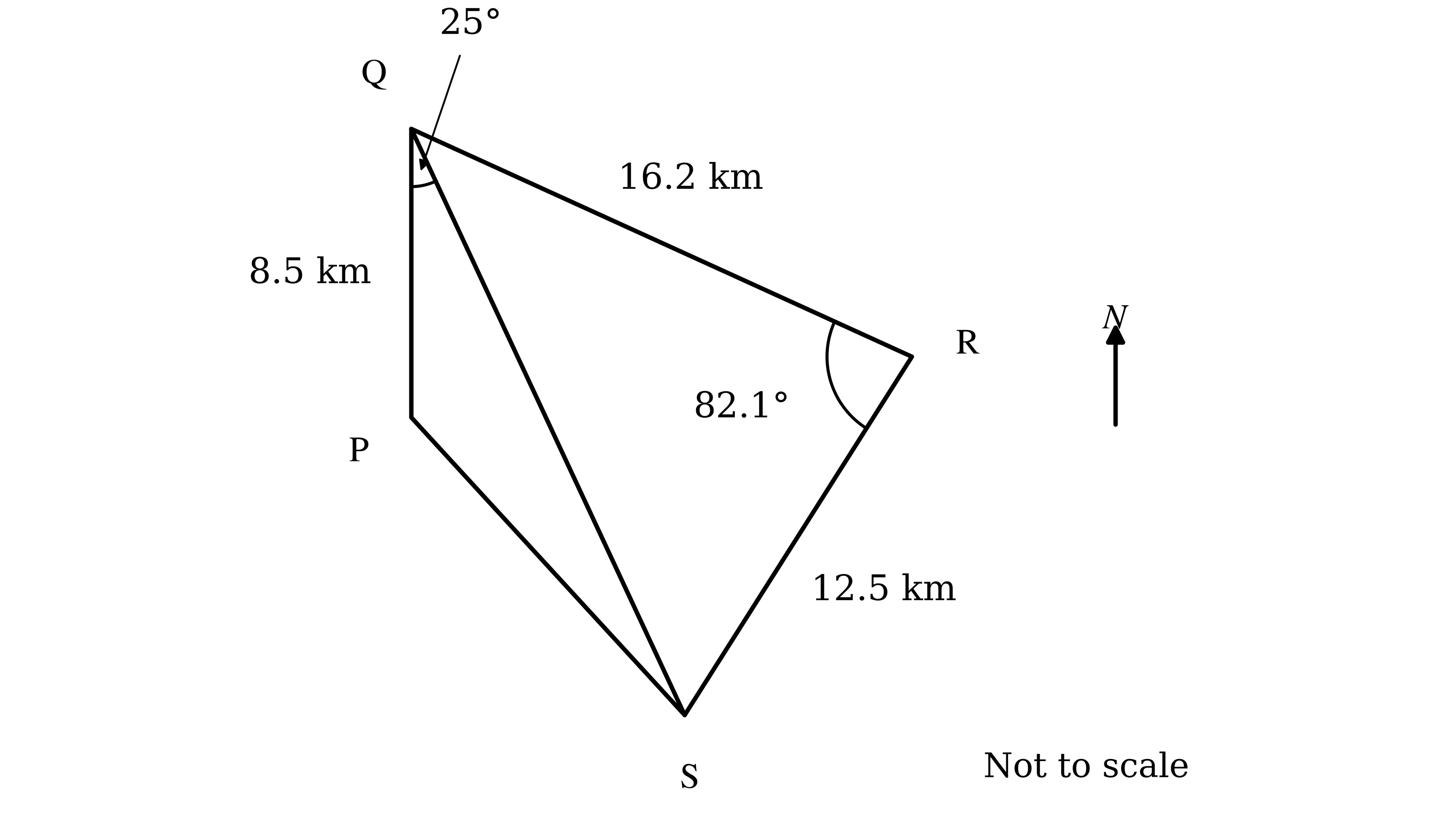
The following diagram shows four islands, P, Q, R and S, where PQ=8.5 km, QR=16.2 km, RS=12.5 km, PQ^S=25° and QR^S=82.1°. Island Q is due north of island P.

Diagram, not to scale, of four islands P, Q, R and S joined in the order Q, R, S, P, with a line from Q to S. Q is due north of P, and PQ is labelled 8.5 km. QR is labelled 16.2 km and RS is labelled 12.5 km. The angle at Q between QP and QS is labelled 25 degrees, and the angle at R between RQ and RS is labelled 82.1 degrees. An arrow labelled N points north.

Mark makes deliveries around the islands. He travels from Q to S, then from S to P, and finally from P to R.

Find the total distance Mark travels.

17a
3 marks

The diagram below shows a pyramid ABCDE with a rectangular base ABCD, where DC=5.9 cm, AD=3.7 cm and AE=7.4 cm. The vertex E is directly above the centre of the base.

q1-3-3-very-hard-trigonometry-ib-maths-

Find AE^C.

17b
3 marks

P is a point on the edge EB such that EP:PB=1:4.

Find the area of triangle EPD.

18a
3 marks

The diagram below shows a police helicopter at point B using a beam of light to search an area of horizontal ground between A and C. The edge of the beam furthest from the helicopter, BC, is 22 m long, and the angle of depression from the helicopter to C is 47°.

q2-3-3-very-hard-trigonometry-ib-maths-

The area of the cross-section of the beam, triangle ABC, is 23 m².

Find AC, the length of ground lit by the beam.

18b
4 marks

Find AB^C, the angle of the beam.

19a
4 marks

A piece of playground equipment has two ropes fixed to a hook at point A on the edge of a gap. The ropes are pulled taut across the gap and fixed at points B and C on the other side. The left embankment is 2.3 m high. B is at the top of the right embankment, and C is vertically below B, 0.8 m above the ground. The angle between the ropes is 23°, and the horizontal width of the gap is 1.4 m. This information is shown in the diagram below.

q5-3-3-very-hard-trigonometry-ib-maths-

Find BC.

19b
4 marks

A third rope, of length 0.9 m, is fixed at B and at a point P on the rope AC.

Find BP^C and hence find PC.

20a
3 marks

A pitched roof is made from a timber frame, ABCDEF. Its horizontal rectangular base ADFC measures 15.3 m by 8.2 m. The ridge BE is parallel to AD, and its midpoint is directly above the point where [AF] and [CD] intersect. BE is 12.1 m long and is 2.2 m above the base ADFC.

q8-3-3-very-hard-trigonometry-ib-maths-

Find the total length of timber needed for the frame.

20b
3 marks

An internal beam runs from M, the midpoint of AC, to E.

Find ME.

21a
5 marks

In the diagram below, AB, BC and AC are steel beams on the first floor of a building under construction. Triangle ABC lies in a horizontal plane 5 m above the ground, with AB=7.9 m, BC=5.8 m and AC=8.3 m. Viewed from above, the beam AB is on a bearing of 078° from A.

q9-3-3-very-hard-trigonometry-ib-maths-

A pot of paint has been left on beam BC at M, halfway between B and C.

Find the bearing of the pot of paint from A.

21b
3 marks

A workman stands on the second floor of the building, directly above A, with his eyes 12 m above the ground.

Find

(i) the angle of depression,

(ii) the distance

from the workman's eyes to the pot of paint.

22
6 marks

A tent has a symmetrical triangular cross-section, ABC, and stands on horizontal ground. The perpendicular height of the tent is 1.2 m. Guy ropes are attached at points X and Y on AB and BC, where BX=BY=0.7 m. Each guy rope is 1.1 m long, and they are fixed to the ground at points P and Q so that PX^A=QY^C=30°. The points A, B, C, P, Q, X and Y all lie in the same vertical plane, as shown in the diagram below.

q10-3-3-very-hard-trigonometry-ib-maths-

Find PQ, the distance between the points where the guy ropes are fixed.

1a
2 marks

The diagram below shows a door wedge, ABCDEFGH. ADEH is a horizontal surface and the angles GH^D and FE^A are right angles. The face ABCD is a square face parallel to EFGH, with the midpoints of [AD] and [EH] aligned. FG=12 cm, GH=7 cm, DH=15 cm and AD=2 cm. This information is represented in the diagram below.

q6a-3-2-very-hard-ib-ai-sl-maths

Find the size of the angle CG^H.

1b
4 marks

Calculate the length AG.

1c
4 marks

(i) Find the perpendicular distance between [BC] and [FG].

(ii) Hence find the angle that the plane BCFG makes with the horizontal.

2
7 marks

A spider spins a web in a single plane. The web has 7 vertices, A, B, C, D, E, F and G, equally spaced around a centre point O. Threads of equal length join each pair of neighbouring vertices (AB, BC, and so on), and a thread joins each vertex to the centre (OA, OB, and so on). This is shown in the diagram below.

q3-3-3-very-hard-trigonometry-ib-maths-

The spider then adds a thread from each vertex to the midpoint of the next thread to the centre, moving clockwise around the web; for example, from G to the midpoint of OA.

The spider can produce 220 cm of silk in a day.

Find the maximum possible length of OA if the spider is to complete the web in one day.

3a
6 marks

The diagram below shows a funnel in the shape of a right cone with a smaller cone removed from its end. The circular faces at the two ends are parallel. The perpendicular height of the complete cone is 168 mm. The diameter of the funnel is 98 mm at its upper end and 7 mm at its lower end.

A grain of sugar is left at point P, 13 of the way up the slanted height of the funnel. An ant sits at point A on the top edge of the funnel. [AB] is a diameter of the larger circular face, and the points A, B, P and the axis of the cone lie in a single plane.

q4-3-3-very-hard-trigonometry-ib-maths-

Find AP, the direct distance between the ant and the grain of sugar.

3b
3 marks

Find the angle of depression from the ant to the grain of sugar.

4
4 marks

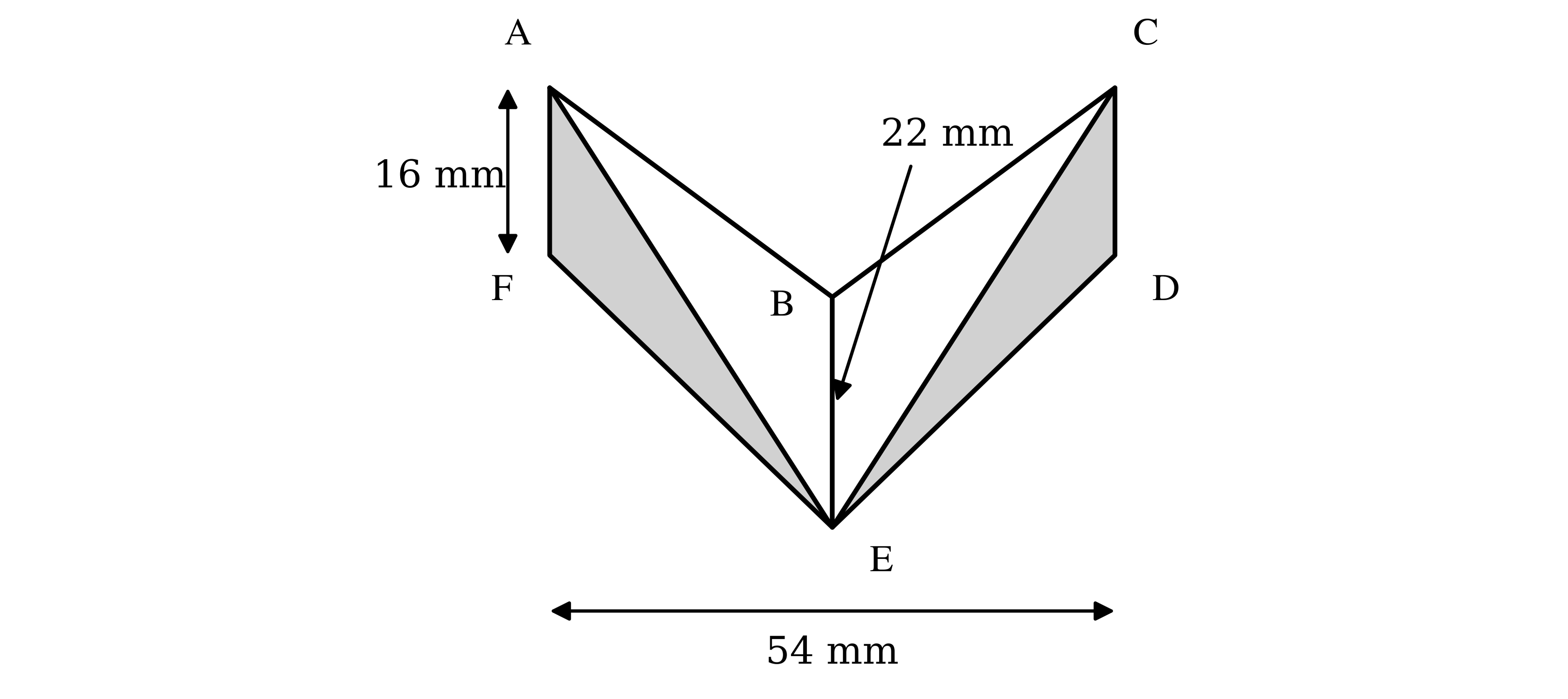
A pendant for a necklace is made in the shape of a symmetrical hexagon, ABCDEF, as shown in the diagram below. AF, BE and CD are parallel, BE=22 mm and AF=CD=16 mm. AB=BC and EF=DE. The total width of the pendant is 54 mm.

The shaded triangles AFE and CDE are made of silver, and the rest of the pendant is made of gold.

Pendant in the shape of a hexagon ABCDEF, symmetrical about the vertical line BE. AF and CD are vertical sides. AF is marked 16 mm, BE is marked 22 mm, and the total width from AF to CD is 54 mm. E is at the bottom and B is below the level of A and C. The lines AE, BE and CE are drawn, and the triangles AFE and CDE are shaded.

Find the percentage of the area of the pendant that is silver.

5a
3 marks

The 'H' on the Hollywood sign is 13.7 m high, measured along its rear face. Each leg is 3 m wide and the gap between the legs is 4 m. The cross bar is as wide (measured from top to bottom in the diagram) as each leg, and it is centred on the height of the 'H'. This information is shown in the diagram below.

q7-3-3-very-hard-trigonometry-ib-maths-

The 'H' stands on horizontal ground but is tilted backwards, so that its rear face makes an angle of 5° with the vertical. During repairs, a metal support bar is fixed between a point A on the ground and the point M, the midpoint of the rear of the cross bar. B is the midpoint of the gap between the legs at ground level. The plane containing A, M and B is perpendicular to the rear face of the 'H', and the angle between the support bar and the rear face, AM^B, is 30°.

Find the length of the support bar.

5b
8 marks

More support bars are needed, from the ground to the midpoint of the top of the rear face of each leg. These supports meet the ground at the same point, A, as the first support bar.

Find

(i) the length of one of these supports,

(ii) the angle that it makes with the horizontal.