1a1 mark
A particle moves in a straight line. At time seconds, the displacement of from its initial position is m, where
Find the displacement of when .
1b2 marks
Find the velocity of when .
Was this exam question helpful?
Exam code: 9709
A particle moves in a straight line. At time seconds, the displacement of from its initial position is m, where
Find the displacement of when .
Find the velocity of when .
Was this exam question helpful?
A particle moves in a straight line. At time seconds, the velocity of the particle is , where
for .
Find the time at which the velocity of the particle is 1 .
Find the acceleration of the particle when .
Was this exam question helpful?
A particle moves in a straight line. At time seconds, the acceleration of the particle is , where
Find the value of at which the acceleration of the particle is 10 .
Given that the velocity of the particle is 68 when , find the velocity of the particle when .
Was this exam question helpful?
A particle moves in a straight line, starting from a point . At time seconds after leaving , the velocity of the particle is , where
Find the value of , other than , at which the particle is instantaneously at rest.
Find the value of , other than , at which the particle is next at .
Was this exam question helpful?
A particle moves in a straight line. At time seconds, the velocity of the particle is , where
for , and
for .
(i) Find the initial speed of the particle.
(ii) Write down the acceleration of the particle for .
Find the acceleration of the particle when .
Show that the displacement of the particle from its initial position, for , is given by
Was this exam question helpful?
A particle moves in a straight line. At time seconds, the acceleration of is , where
Show that the displacement, m, of from a fixed point on the line is given by
where and are constants.
Given that starts from rest at , write down the values of and , and find the displacement of from when .
Was this exam question helpful?
A particle moves in a straight line. At time seconds, the velocity of the particle is , where
for .
(i) Find the values of for which the particle is instantaneously at rest.
(ii) Sketch the velocity-time graph for the motion of the particle for .
(i) Show that the distance travelled by the particle between and is m.
(ii) Find the distance travelled by the particle between and .
(i) Find the total distance travelled by the particle between and .
(ii) Find the displacement of the particle from its initial position when .
Was this exam question helpful?
A particle moves in a straight line. At time seconds, the velocity of the particle is , where
for .
(i) Write down the initial velocity of the particle.
(ii) Find the value of at which the particle is instantaneously at rest.
Show that the acceleration of the particle is negative for the first 2 seconds of its motion.
Was this exam question helpful?
An athlete training for the 100 m sprint aims to run according to the model
where m is the displacement of the athlete from the starting point at time seconds.
Find, according to the model, the time the athlete takes to complete the 100 m sprint. Give your answer correct to 3 significant figures.
Show that, according to the model, the acceleration of the athlete is constant.
Was this exam question helpful?
A home-made rocket is launched from rest at ground level at time and moves vertically upwards. At time seconds after launch, the acceleration of the rocket is , where
(i) Write down the acceleration of the rocket at launch.
(ii) Find the acceleration of the rocket when .
(i) Find an expression for the velocity, , of the rocket in terms of .
(ii) Find an expression for the height, m, of the rocket above the ground in terms of .
Was this exam question helpful?
In a cheese-rolling competition, a cylindrical block of cheese rolls down a hill, starting from rest at the top of the hill. At time seconds, the acceleration of the cheese is modelled as , where
for . The cheese reaches the bottom of the hill when .
Find the velocity of the cheese when it reaches the bottom of the hill.
Find the length of the hill, as travelled by the cheese.
Was this exam question helpful?
A high-speed train leaves a station from rest at time . Its displacement from the station at time seconds is m, where
for , and is a constant.
Find an expression, in terms of and , for the velocity of the train for .
The acceleration of the train is 0.6 when .
Find the value of .
Find the distance travelled by the train in the first 20 seconds.
Was this exam question helpful?
A particle moves in a straight line, starting from rest at a fixed point . The displacement of from at time seconds is m, where
(i) Find the displacement of from when .
(ii) Find the value of , other than , at which is back at .
Find the greatest displacement of from before it returns to .
Was this exam question helpful?
A go-kart manufacturer is testing a new model on a straight horizontal road. The go-kart starts from rest, and its velocity at time seconds is modelled by
for .
Find the maximum velocity of the go-kart and the time at which it occurs. Justify that this is a maximum.
The test ends when the go-kart next comes to rest. Find the time at which the test ends.
Was this exam question helpful?
A particle moves along a straight line. At time seconds, the acceleration of the particle is , where
for . The velocity of the particle is 8 when .
Find an expression for the velocity of the particle in terms of .
(i) Find the value of , other than , at which the velocity of the particle is zero.
(ii) Hence state the set of values of for which the velocity of the particle is positive.
Was this exam question helpful?
A particle moves in a straight line. At time seconds, the velocity of the particle is , where
for .
Sketch the velocity-time graph for the motion of the particle for .
Show that the total distance travelled by the particle for is m.
Was this exam question helpful?
A particle moves along a straight line. At time seconds, the velocity of the particle is , where
for .
Find the values of at which the particle is instantaneously at rest.
Find the distance travelled by the particle while its velocity is negative.
Was this exam question helpful?
A go-kart manufacturer is testing a new model on a straight horizontal road. The go-kart starts from rest, and its velocity at time seconds is modelled by
for , where is a constant.
Given that the maximum speed of the go-kart is 32 , find the value of and the time at which the go-kart reaches its maximum speed.
(i) Find the maximum acceleration of the go-kart.
(ii) Justify that your answer to part (i) is a maximum.
Was this exam question helpful?
A home-made rocket is launched from rest at ground level at time and moves vertically. At time seconds after launch, the acceleration of the rocket is , where
(i) Find an expression for the velocity of the rocket in terms of .
(ii) Find the value of , other than , at which the velocity of the rocket is zero. Give your answer correct to 3 significant figures.
Find the greatest height reached by the rocket, giving your answer in kilometres correct to 3 significant figures.
Was this exam question helpful?
A zip-wire runs in a straight horizontal line between two trees in a children's park. A child on the zip-wire leaves the first tree from rest at time . The velocity-time graph shows the motion of the child, where is the velocity of the child at time seconds.
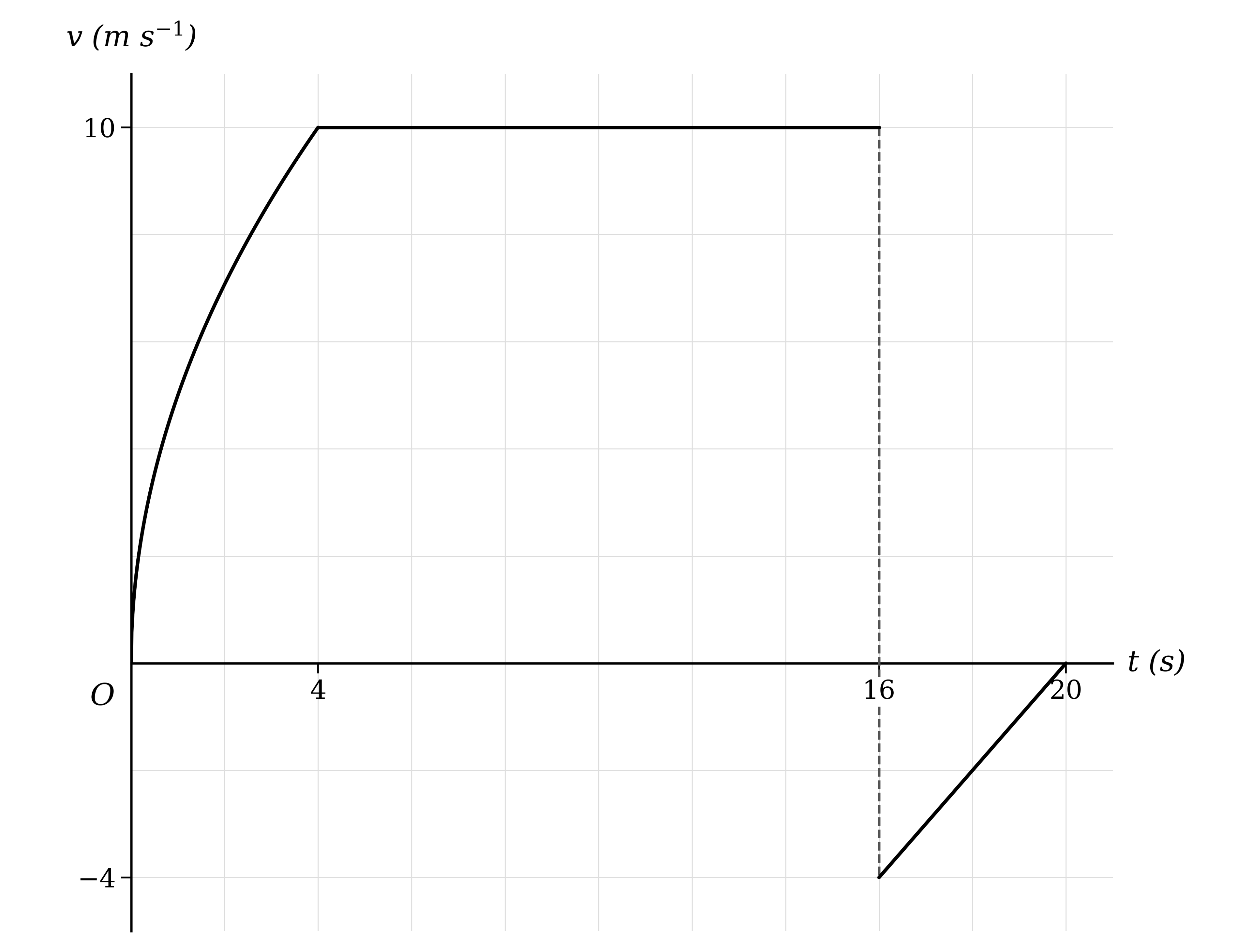
For , the velocity is given by . The child reaches the second tree at and rebounds from it, then moves back towards the first tree, coming to rest at .
(i) Find the distance between the two trees.
(ii) Find the distance of the child from the second tree when the child comes to rest.
Find the acceleration of the child when .
Was this exam question helpful?
A bullet train leaves a station from rest at time . For , the displacement of the train from the station is m, where
During this time the acceleration of the train increases until it reaches its maximum value of 0.72 .
Show that the train reaches its maximum acceleration when .
After reaching its maximum acceleration, the train continues to accelerate at 0.72 until its velocity reaches 75 .
Find the time taken for the velocity of the train to increase to 75 at this constant acceleration.
The train then travels at a constant velocity of 75 for 10 minutes.
Find the displacement of the train from the station at the end of these 10 minutes. Give your answer in kilometres correct to 3 significant figures.
Was this exam question helpful?
A particle moves in a straight line. At time it passes through a fixed point with velocity 36 . For , the acceleration of the particle is , where
Find the values of at which the particle is instantaneously at rest.
Find the total distance travelled by the particle for .
Was this exam question helpful?
A car travels along a straight horizontal road and passes a service station at time . The displacement of the car from at time seconds is modelled as m, where
for .
Show that, according to the model, the car never returns to .
Show that the car is decelerating for the first seconds after passing .
Was this exam question helpful?
A particle moves along a straight line. At time seconds, the velocity of the particle is , where
for .
Find the values of at which the particle is instantaneously at rest.
Find the set of values of for which the acceleration of the particle is negative.
Was this exam question helpful?
A go-kart manufacturer is testing a new model on a straight horizontal road. The go-kart starts from rest, and its velocity at time seconds is modelled by
for , and
for , where is a constant. There is no instantaneous change in the velocity of the go-kart at .
Show that .
Find the maximum velocity of the go-kart for , and find the value of , where , at which the go-kart is instantaneously at rest.
Was this exam question helpful?
A home-made rocket is launched from rest at ground level at time . It moves in a vertical straight line, first upwards and then back down to the ground. At time seconds after launch, the acceleration of the rocket is , taking upwards as positive, where
Find the total time for which the rocket is in the air. Give your answer correct to 3 significant figures.
Find the total distance travelled by the rocket. Give your answer correct to 3 significant figures.
Was this exam question helpful?
In a cheese-rolling competition, a cylindrical block of cheese starts from rest at the top of a hill at time . It rolls down the hill and reaches the flat ground at the bottom when , then slows down along the flat ground. The acceleration of the cheese at time seconds is modelled as , where
for , and
for , where is a constant. There is no instantaneous change in the velocity of the cheese at , and the cheese comes to rest when its acceleration is .
By first finding the value of , find the total distance the cheese rolls before it comes to rest.
Was this exam question helpful?
A high-speed train leaves a station from rest at time . Its displacement from the station at time seconds is m, where
for , and and are constants with .
In the first 10 seconds, the average velocity of the train is and the average acceleration of the train is .
By first finding the values of and , find an expression for the acceleration of the train for .
Was this exam question helpful?
A particle moves in a straight line, starting from a point . At time hours after leaving , the acceleration of the particle is , where
for . When , the particle is back at .
Show that the velocity, , of the particle at time hours is given by
where is a constant to be found.
Find the exact total distance travelled by the particle for .
Was this exam question helpful?