Area Under a Force-Displacement Graph (AQA A Level Physics): Revision Note
Exam code: 7408

Area under a force-displacement graph
The work done by a force acting over a distance can also be found from a force-displacement graph
If the force is not constant and is plotted against the displacement of the object:
The work done is equal to the area under the force-displacement graph
This is because:
The work done is therefore equivalent whether there is:
a small force over a long displacement
a large force over a small displacement
The graph may need to be split up into sections
The total area is the sum of the areas of each section

Worked Example
The graph shows how a force varies over a displacement of 80 m.
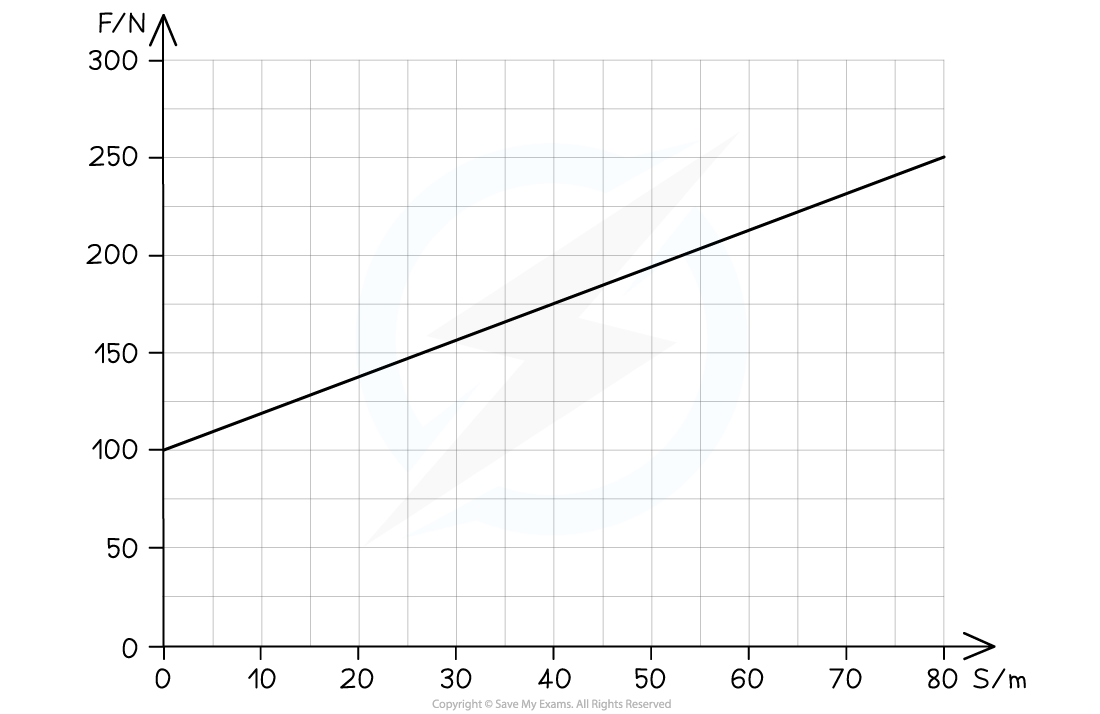
Calculate the work done.
[3]
Answer:
Step 1: Split the graph into sections
The work done is the area under the graph
The total area can be found by splitting the graph into sections A and B
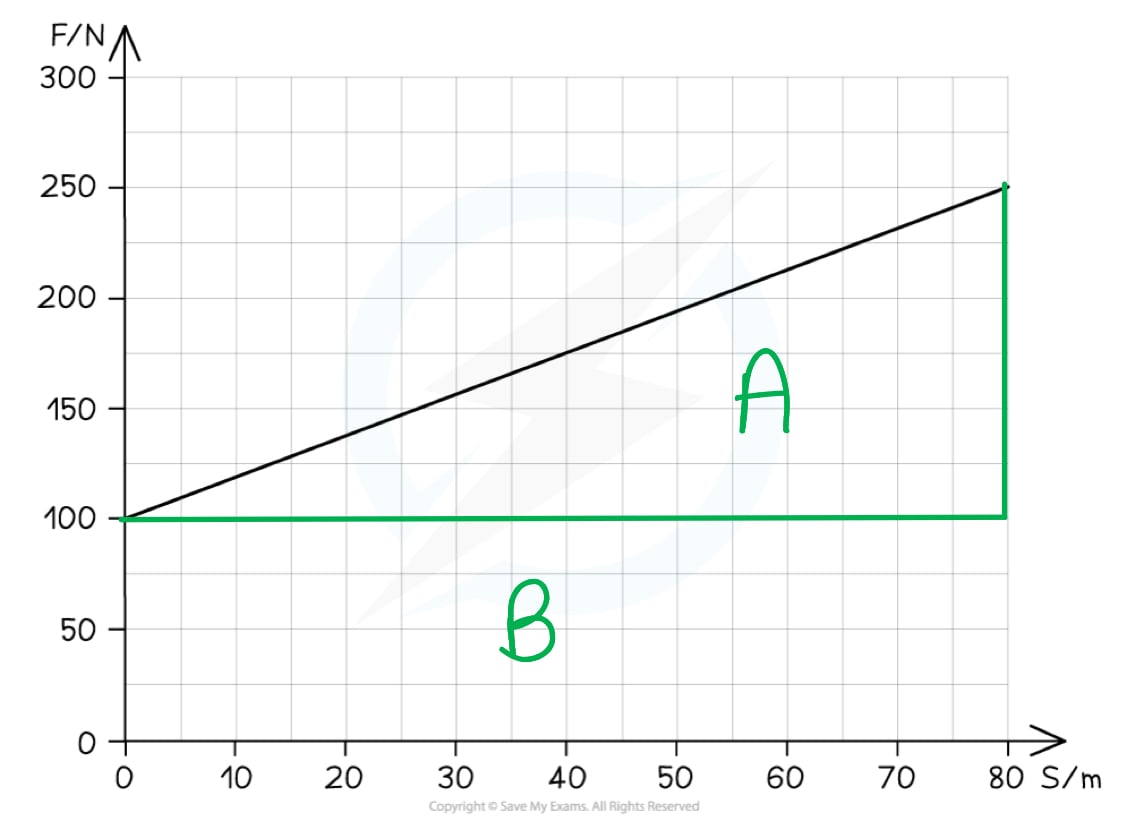
Step 2: Calculate the area of section A
Section A is a right-angled triangle where the area is 0.5 × base × height
[1 mark]
Step 3: Calculate the area of section B
Section B is a rectangle where the area is base × height
[1 mark]
Step 4: Calculate the total work done
The total work done is the sum of both areas
[1 mark]
Examiner Tips and Tricks
Always check the units on the axes when calculating values from a graph. Sometimes the force will be given in kN or the displacement in km. These must be converted into SI units to calculate the work done in J.
Variable forces
The force on an object may not always be constant, this is known as a variable force
This is more representative of a force in real life
If a force is constant, then the following equations can be used:
If a force is varying, the above equations cannot be used, instead, work done must be found from the area under the force-displacement graph
If a varying force increases, then an object’s acceleration increases and vice versa
Worked Example
A person is pulling a suitcase through an airport with a rough surface. They apply a force of 150 N over a distance of 12 m. Afterwards, the person gets progressively tired and the applied force is linearly reduced to 60 N. The total distance through which the suitcase has moved is 25 m.
Calculate the work done by the force applied by the person over 25 m.
[3]
Answer:
Step 1: Sketch a force-displacement graph and split it into sections
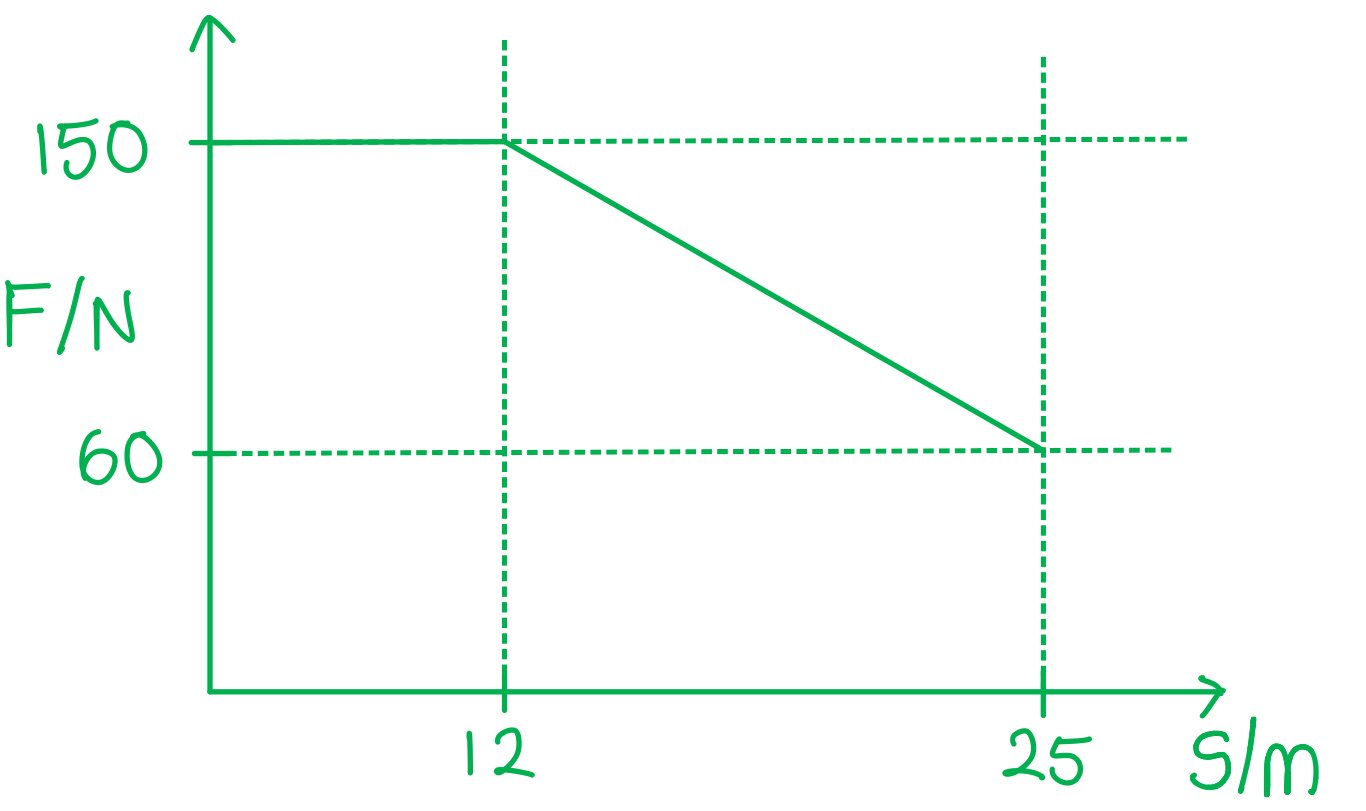
Step 2: Split the graph into sections
The work done is the area under the graph
The total area can be found by splitting the graph into sections A and B
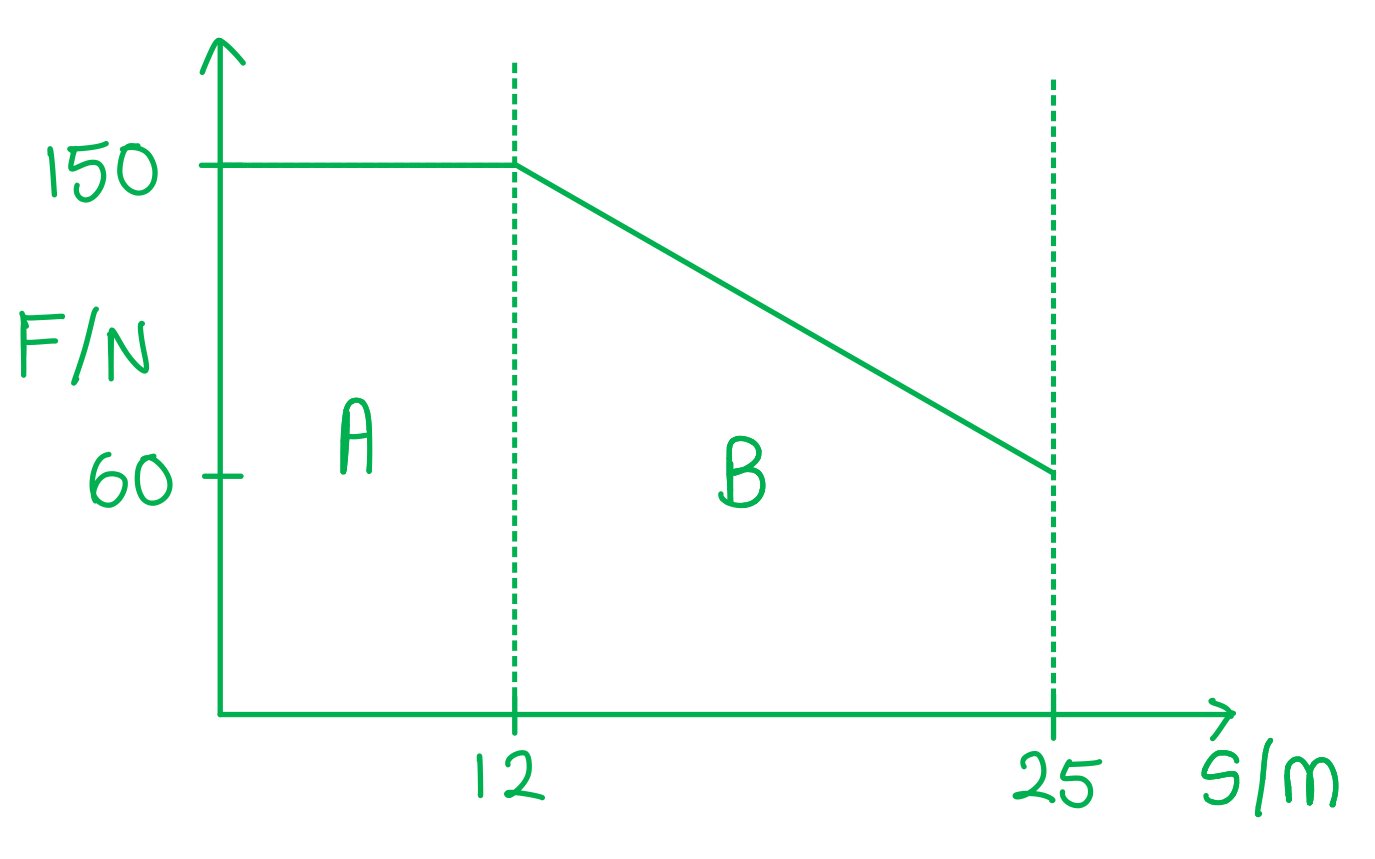
Step 3: Calculate the area of section A
Section A is a rectangle where the area is base × height
[1 mark]
Step 4: Calculate the area of section B
Section B is a trapezium, which can be split into a right-angled triangle and a rectangle
[1 mark]
Step 5: Calculate the total work done
The total work done is the sum of both areas
[1 mark]
Examiner Tips and Tricks
When you sketch a graph, it doesn't have to be to scale. However, make sure you label the key points from the question on the x- and y-axes, so you can calculate the areas underneath the graph.

Unlock more, it's free!
Join the 100,000+ Students that ❤️ Save My Exams
the (exam) results speak for themselves:

Was this revision note helpful?
Build on this topic