Graphs (Edexcel A Level Further Maths: Decision 1): Exam Questions

Exam code: 9FM0

38 mins5 questions
1a
Sme Calculator
2 marks

A simply connected graph is a connected graph in which any two vertices are directly connected by at most one arc and no vertex is directly connected to itself.

Given that a simply connected graph has exactly four vertices,

(i) write down the minimum number of arcs it can have, 

(ii) write down the maximum number of arcs it can have.

1b
Sme Calculator
3 marks

(i) Draw a simply connected graph that has exactly four vertices and exactly five arcs. 


(ii) State, with justification, whether your graph is Eulerian, semi-Eulerian or neither.

1c
Sme Calculator
5 marks

By considering the orders of the vertices, explain why there is only one simply connected graph with exactly four vertices and exactly five arcs.

2a
Sme Calculator
1 mark

Draw the graph K5

2b
Sme Calculator
3 marks

(i) In the context of graph theory explain what is meant by ‘semi-Eulerian’. 

(ii) Draw two semi-Eulerian subgraphs of K5, each having five vertices but with a different number of edges. 

2c
Sme Calculator
2 marks

Explain why a graph with exactly five vertices with vertex orders 1, 2, 2, 3 and 4 cannot be a tree.

3a
Sme Calculator
2 marks
fig-1-specimen-2017-9fm0-3d

Figure 1

Define what is meant by a planar graph.

3b
Sme Calculator
1 mark

Starting at A, find a Hamiltonian cycle for the graph in Figure 1.

3c
Sme Calculator
4 marks

Arc AG is added to Figure 1 to create the graph shown in Figure 2.

q2-fig-2-specimen-2017-9fm0-3d

Figure 2

Taking ABCDEFGA as the Hamiltonian cycle,

use the planarity algorithm to determine whether the graph shown in Figure 2 is planar. You must make your working clear and justify your answer.

4a
1 mark
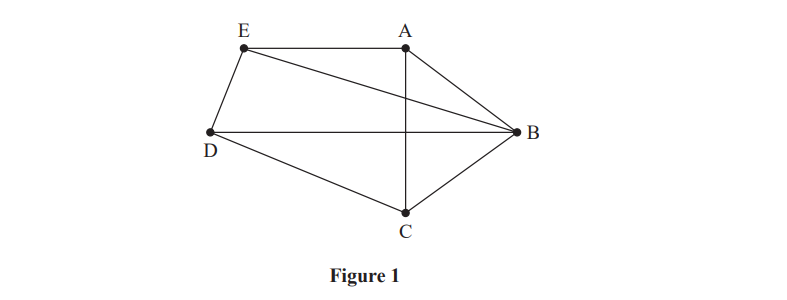
Diagram of a pentagon with vertices labelled A to E. Lines connect vertices, forming triangles ABE, ABD, and ABC. Labelled as Figure 1.

Figure 1 shows the graph G

State whether G is Eulerian, semi-Eulerian, or neither, giving a reason for your answer.

4b
1 mark

Write down an example of a Hamiltonian cycle on G.

4c
1 mark

State whether or not G is planar, justifying your answer.

4d
1 mark

State the number of arcs that would need to be added to G to make the graph K5

4e
1 mark
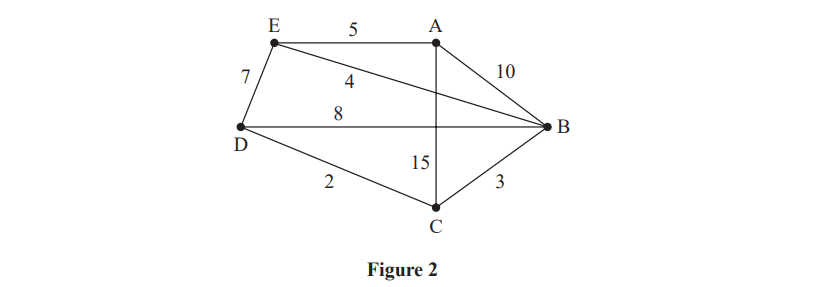
Pentagon EADBC with labelled vertices and edge lengths: EA 5, AB 10, BC 3, CD 2, DE 7, diagonal EB 4, diagonal DB 8, diagonal AC 15.

Direct roads between five villages, A, B, C, D and E, are represented in Figure 2. The weight on each arc is the time, in minutes, required to travel along the corresponding road. Floyd’s algorithm is to be used to find the complete network of shortest times between the five villages.

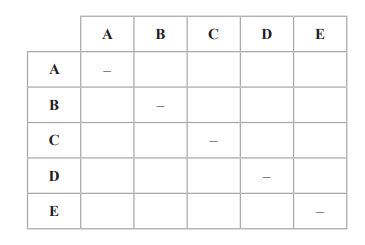
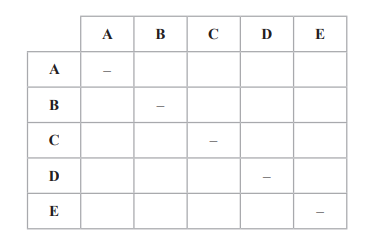
For the network represented in Figure 2, complete the initial time matrix in the table below.

Grid with five rows and columns labelled A to E; dashes appear diagonally from top left A-A to bottom right E-E.
4f
Sme Calculator
2 marks

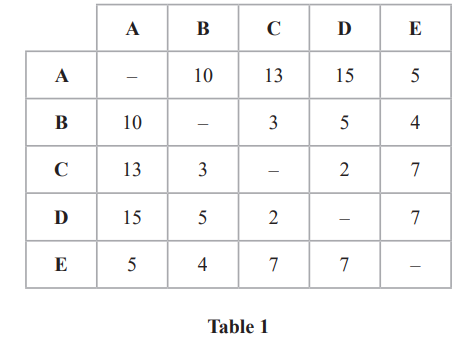
The time matrix after four iterations of Floyd’s algorithm is shown in Table 1.

Table 1 shows a grid with columns and rows labelled A to E, containing numerical values and dashes. Values represent data between the items.

Perform the final iteration of Floyd’s algorithm that follows from Table 1, showing the time matrix for this iteration.

Matrix grid with cells labelled A to E on both axes; diagonal cells from top left to bottom right contain dashes.
5a
1 mark

Explain why it is not possible to draw a graph with exactly six nodes with degrees 1, 2, 3, 4, 5 and 6

A tree, T, has exactly six nodes. The degrees of the six nodes of T are

1

2

left parenthesis 4 space – space x right parenthesis

left parenthesis 2 x space – space 5 right parenthesis

left parenthesis 4 x space – space 11 right parenthesis

left parenthesis 3 x space – space 5 right parenthesis

where x is an integer.

5b
1 mark

Explain how you know that T cannot be Eulerian.

5c
Sme Calculator
5 marks

(i) Determine the value of space x space

(ii) Hence state whether T is semi-Eulerian or not. You must justify your answer.

5d
1 mark
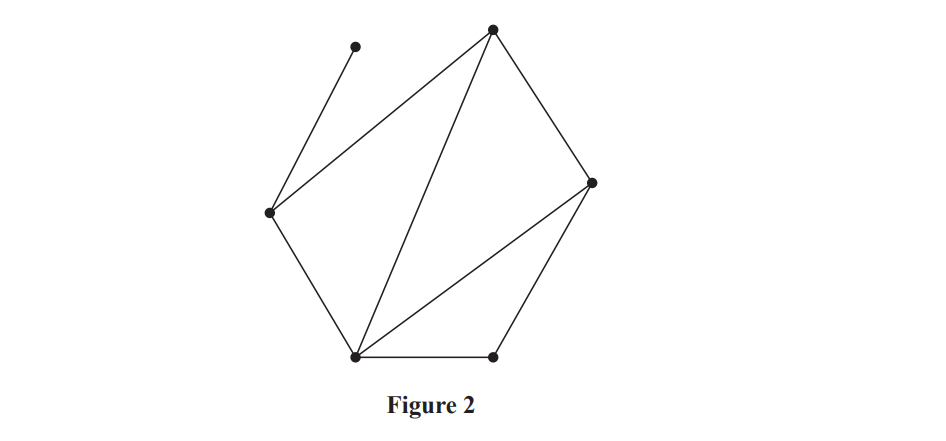
Irregular pentagon with vertices connected by additional lines, forming intersecting segments. Text below reads "Figure 2".

Figure 2 shows a graph, G, with six nodes with degrees 1, 2, 3, 3, 3 and 4

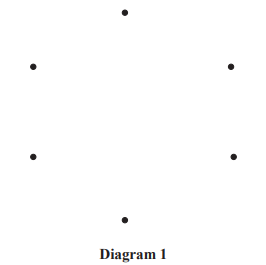
Using the vertices in Diagram 1, draw a graph with exactly six nodes with degrees 1, 2, 3, 3, 3 and 4 that is not isomorphic to G.

Seven black dots are arranged in a hexagonal pattern with one dot in the centre, labeled "Diagram 1" below.