Polar Coordinates (Edexcel A Level Further Maths: Core Pure): Exam Questions

Exam code: 9FM0

58 mins6 questions
1a
2 marks
qp3a

Figure 1 shows the design for a table top in the shape of a rectangle ABCD. The length of the table, AB, is 1.2 m. The area inside the closed curve is made of glass and the surrounding area, shown shaded in Figure 1, is made of wood.

The perimeter of the glass is modelled by the curve with polar equation

r=0.4+acos2θ      0≤θ<2π

where a is a constant.

Show that a=0.2

1b
8 marks

Hence, given that AD=60 cm, find the area of the wooden part of the table top, giving your answer in m2 to 3 significant figures.

2
9 marks
qp3-9fm0_01-ms-june-2020

Figure 1 shows a sketch of two curves C1 and C2 with polar equations

C1 : r = (1 + sin θ)      0 ≤ θ < 2π

C2: r=3(1−sin θ)        0 ≤ θ < 2π

The region R lies inside C1 and outside C2 and is shown shaded in Figure 1.

Show that the area of R is

 p3 − qπ

where p and q are integers to be determined.

3
9 marks
qp4-9fm0-01-ms-further-maths

The curve C shown in Figure 1 has polar equation

r = 4 + cos 2θ      0≤θ≤π2

At the point A on C, the value of r is 92

The point N lies on the initial line and AN is perpendicular to the initial line.

The finite region R, shown shaded in Figure 1, is bounded by the curve C, the initial line and the line AN.

Find the exact area of the shaded region R, giving your answer in the form  pπ+q3 where  p and q are rational numbers to be found.

4a
6 marks

(i) Show on an Argand diagram the locus of points given by the values of z satisfying

|z − 4 − 3i| = 5

Taking the initial line as the positive real axis with the pole at the origin and given that θ∈[α, α+π], where α=−arctan (43),

(ii) show that this locus of points can be represented by the polar curve with equation

r = 8cosθ+6sinθ

4b
7 marks

The set of points A is defined by

A={z : 0 ≤ arg z ≤π3}∩{z : |z−4−3i|≤ 5}

(i) Show, by shading on your Argand diagram, the set of points A.

(ii) Find the exact area of the region defined by A, giving your answer in simplest form.

5a
2 marks

In this question you must show all stages of your working.

Solutions relying entirely on calculator technology are not acceptable.

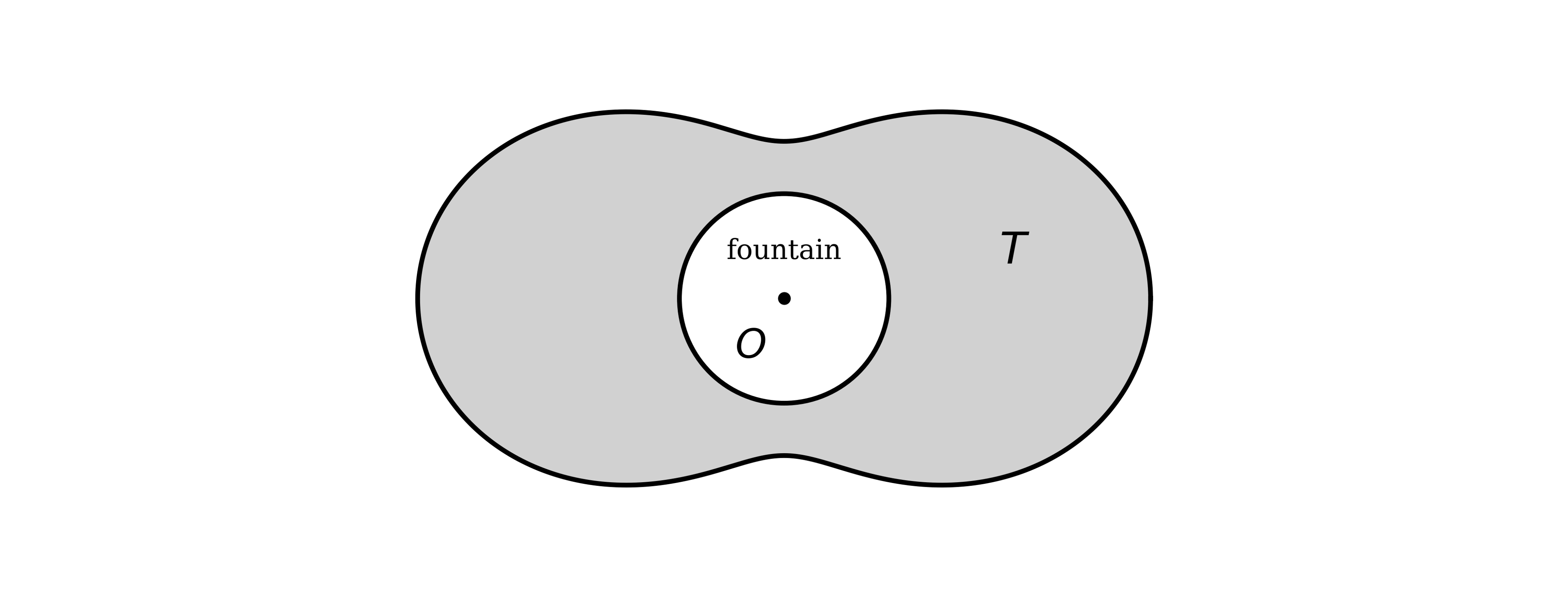
A schematic diagram of a flower bed. A small circular fountain of radius 2 metres is centred at the point O. Surrounding the fountain is a shaded planted region labelled T, bounded on the inside by the fountain and on the outside by a peanut-shaped closed curve (the polar curve r = 5 + a cos 2 theta), which reaches farthest from O in the horizontal direction and is pinched closest to O in the vertical direction.
Figure 1

Figure 1 shows a design for a flower bed. A circular fountain of radius 2 m has centre O. The fountain is surrounded by a planted region T, shown shaded in Figure 1.

The region T is bounded by the fountain and by a curved outer edge. The outer edge is modelled by the curve with polar equation

r=5+acos2θ,  0≤θ<2π

where a is a positive constant.

Given that the shortest distance between the fountain and the outer edge of the flower bed is 1 m,

determine the value of a.

5b
6 marks

Hence, using algebraic integration, determine, according to the model, the exact area of T.

6a
4 marks

The locus C is given by

|z−2i|=2

The locus D is given by

argz=π6

Sketch, on the same Argand diagram, the locus C and the locus D.

6b
1 mark

The set of points A is defined by

A={z:|z−2i|≤2}∩{z:π6≤argz≤π2}

Show, by shading on your Argand diagram, the set of points A.

6c
4 marks

Find the area of the region defined by A, giving your answer in the form  pπ+q3 where  p and q are constants to be determined.