Polymer Repeat Units (OCR A Level Chemistry A): Revision Note

Exam code: H432

Philippa Platt

Written by: Philippa Platt

Reviewed by: Caroline Carroll

Updated on

Polymer Repeat Units

Repeat units for addition polymers

  • A repeat unit is the smallest group of atoms that when connected one after the other make up the polymer chain

    • It is represented by square brackets in the displayed and general formula

  • In poly(alkenes) (such as poly(ethene)) and substituted poly(alkenes) (such as PVC) made of one type of monomer the repeating unit is the same as the monomer except that the C=C double bond is changed to a C-C single bond

Equations: n ethene forms poly(ethene) and n chloroethene forms poly(chloroethene); the C=C double bond becomes a C-C single bond and the repeat unit is shown in square brackets with subscript n

The repeating units of poly(ethene) and poly(chloroethene) are similar to their monomer except that the C=C bond has changed into a C-C bond

Worked Example

Identify the monomers present in the given sections of addition polymer molecules:
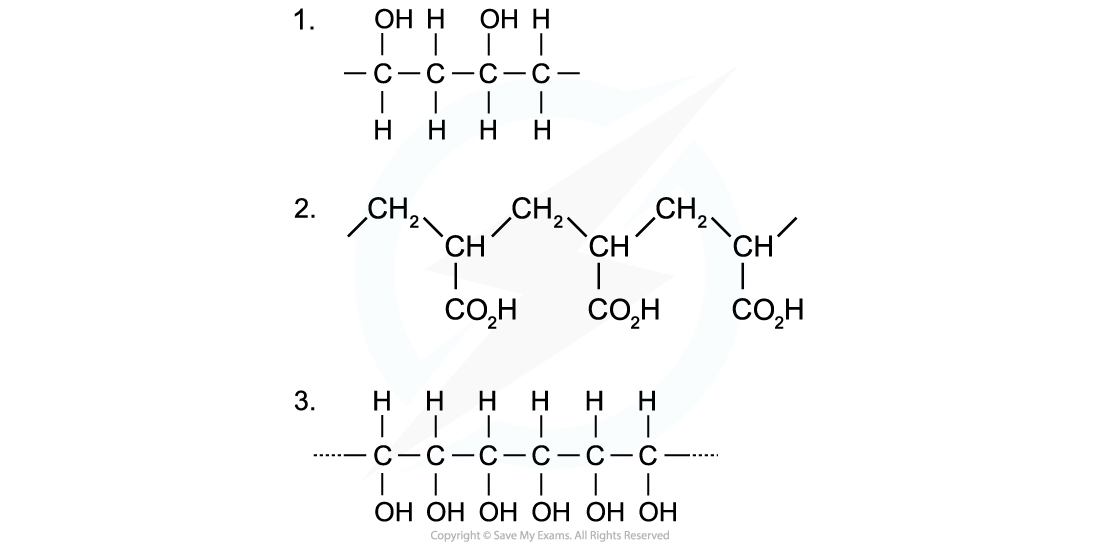
Three sections of addition polymer: 1 a four-carbon chain with OH on alternate carbons (poly(ethenol)); 2 a chain with alternating CH2 and CH(CO2H) (poly(propenoic acid)); 3 a six-carbon chain with one OH on every carbon (poly(ethene-1,2-diol))

Answers:

Answer 1:

When ethenol (CH(OH)=CH2) is polymerised, the C-C double bond opens to produce a repeating unit of CH(OH)-CH2. This gives the polymer poly(ethenol)

Answer 1: ethenol, CH(OH)=CH2, polymerises to poly(ethenol) with repeat unit CH(OH)-CH2; two repeat units shown joined as a four-carbon chain

Answer 2:

  • To find the monomer, first the repeating unit should be deduced. Repeating units have only 2 carbons in the polymer main chain

Answer 2 step 1: a section of the polymer chain -CH2-CH(CO2H)- repeated, with one repeat unit of two main-chain carbons shown in square brackets as poly(prop-2-enoic acid)
  • Since the repeating unit is now found, it can be concluded that the monomer is prop-2-enoic acid

Answer 2 step 2: the monomer prop-2-enoic acid, CH2=CH-CO2H

Answer 3:

  • Again, the repeating unit only has 2 carbons in the polymer chain which in this case are two carbon atoms that each contain one OH group

    • Thus, when ethene-1,2-diol (CH(OH)=CH(OH)) is polymerised, the C=C double bond opens to produce a repeating unit of CH(OH)-CH(OH) which gives the polymer poly(ethene-1,2-diol)

Answer 3: ethene-1,2-diol, CH(OH)=CH(OH), polymerises to poly(ethene-1,2-diol) with repeat unit CH(OH)-CH(OH); three repeat units shown as a six-carbon chain with an OH on each carbon

Repeat units for condensation polymers

  • Remember we can tell the type of polymerisation by identifying the linking between the monomers

  • If a chain of carbon atoms is present, the polymer is an addition polymer

  • If there is an ester link, the polymer is a polyester (formed by condensation polymerisation)

  • If there is an amide link, the polymer is a polyamide (formed by condensation polymerisation)

Section of a polyester, poly(ethylene terephthalate): repeat unit -OCH2CH2-O-CO-C6H4-CO- with the ester link highlighted

This polymer structure shows an ester functional group linking monomers together

Section of a polyamide chain with the amide link, -CO-NH-, highlighted in two places between units bearing R groups

An amide link - also known as a peptide link - is the key functional group in a polyamide

Worked Example

Draw the repeating unit and identify the monomers used to make the following polymers

Worked example question: (a) a section of a polyamide made from an aromatic dicarboxylic acid and a diamine with amide links; (b) a section of an addition polymer with a phenyl group (C6H5) on alternate carbons of a carbon chain

Answer:

Worked example answers: (a) polyamide repeat unit and its two monomers, a 1,3-bis(aminomethyl)benzene diamine and benzene-1,2-dicarboxylic acid; (b) addition polymer repeat unit -CH2-CH(C6H5)- and its monomer phenylethene, CH2=CH(C6H5)

Answer (a): repeat unit -NH-CH2-C6H4-CH2-NH-CO-C6H4-CO- (a polyamide). Monomers: benzene-1,3-diylbis(methanamine), H2NCH2-C6H4-CH2NH2 (1,3 positions), and benzene-1,2-dicarboxylic acid, C6H4(COOH)2 (1,2 positions).

Answer (b): repeat unit -CH2-CH(C6H5)- (addition polymer, poly(phenylethene)). Monomer: phenylethene, CH2=CH(C6H5).

Unlock more, it's free!

Join the 100,000+ Students that ❤️ Save My Exams

the (exam) results speak for themselves:

Build on this topic

Philippa Platt

Author: Philippa Platt

Expertise: Chemistry Content Creator

Philippa has worked as a GCSE and A level chemistry teacher and tutor for over thirteen years. She studied chemistry and sport science at Loughborough University graduating in 2007 having also completed her PGCE in science. Throughout her time as a teacher she was incharge of a boarding house for five years and coached many teams in a variety of sports. When not producing resources with the chemistry team, Philippa enjoys being active outside with her young family and is a very keen gardener

Caroline Carroll

Reviewer: Caroline Carroll

Expertise: Head of Content Delivery

Caroline graduated from the University of Nottingham with a degree in Chemistry and Molecular Physics. She spent several years working as an Industrial Chemist in the automotive industry before retraining to teach. Caroline has over 12 years of experience teaching GCSE and A-level chemistry and physics. She is passionate about delivering high-quality resources to help students achieve their full potential.