Globalisation (Edexcel A Level Business): Exam Questions

Exam code: 9BS0

2 hours16 questions
1
4 marks

Read the following extracts (E to G) (opens in a new tab) before answering

Using the data in Extracts E and F, calculate the amount Pfizer would have saved in 2014 if it had paid corporation tax in Ireland, rather than the USA. You are advised to show your working.

2
4 marks

Extract E

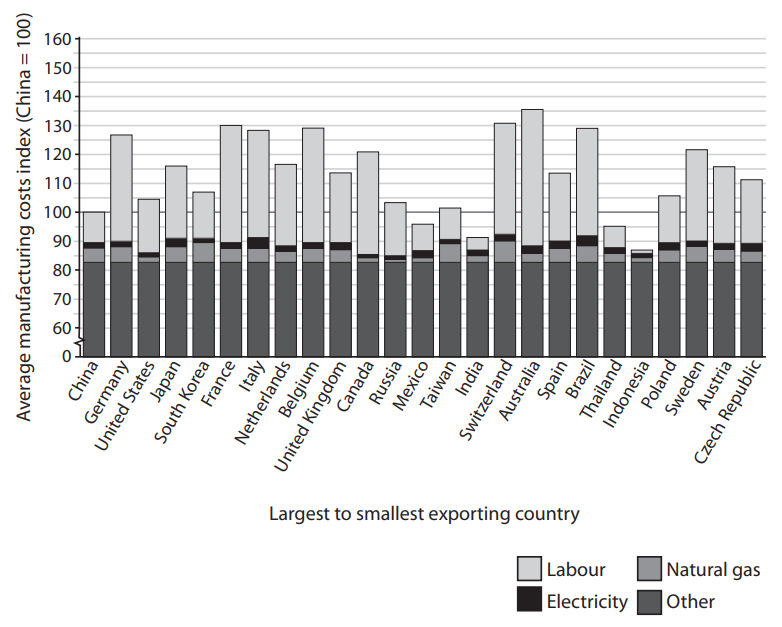
Comparison of the average manufacturing costs in 2014 (China = 100)

Stacked bar chart of 2014 manufacturing-cost indices for countries ordered by export size. The index runs from 0 to 160 (China = 100); bars show labour, natural gas, electricity and other costs, totalling 87 in Indonesia to 136 in Australia.

(Source: adapted from © 2017 The Boston Consulting Group)

Calculate the percentage of the world’s top 25 exporting economies that have costs of production above those of the United Kingdom in 2014. You are advised to show your working.

3
4 marks

Read the following extracts (E to G) (opens in a new tab) before answering

Explain how Ebac Ltd could benefit from exporting its products.

4
4 marks

Read the following extracts (D to G) (opens in a new tab) before answering

Explain one way the Indian government might use legislation to protect the Indian ridesharing market from non-Indian businesses.

5
4 marks

Read the following extracts (D to G) (opens in a new tab) before answering

Explain one reason for Ford's decision to develop an SUV for the Indian market.

6
4 marks

Read the following extracts (D to G) (opens in a new tab) before answering

Explain one way foreign direct investment (FDI) affects businesses in Indonesia.

1
10 marks

Read the following extracts (E to G) (opens in a new tab) before answering

Assess the ways in which specialisation might give a business, such as Pfizer, a competitive advantage when trading internationally.

2
8 marks

Read the following extracts (D to G) (opens in a new tab) before answering

Assess two likely benefits to Lavazza of operating in the NAFTA trading bloc.

3
12 marks

Read the following extracts (D to G) (opens in a new tab) before answering

Assess the implications of future economic growth for the likely success of domestic ridesharing businesses in an emerging economy, such as India.

4
10 marks

Read the following extracts (D to G) (opens in a new tab) before answering

Assess the effect on Nike of Indonesia being a member of the ASEAN trading bloc.

5
10 marks

Read the following extracts (E to H) (opens in a new tab) before answering

Assess the likely effects of protectionism on Northfield Cycles.

6
12 marks

Read Extracts D to G (opens in a new tab) before answering

There are several factors that have contributed to increased globalisation, including transport and communication.

Assess the likely importance of transport and communication for the increased globalisation of the computer games market.

7
12 marks

Read Extracts A to C (opens in a new tab) before answering

Assess the likely impact of increased foreign direct investment (FDI) on the growth of businesses in the UK car industry.

8
10 marks

Extract A

Vinted Ltd: A growing clothing business

Vinted Ltd was founded in Lithuania in 2008 by Milda Mitkute and Justas Janauskas, who remain major shareholders. It operates across Europe and the USA, and recently raised €250m in share capital to help fund expansion into new markets.

Vinted currently has 45 million users who buy and sell clothes on its platform. Sellers pay no fees until the items are sold and then Vinted receives a percentage of the selling price.

Vinted utilises several trends, such as affordable fashion, and the use of online channels. Vinted is part of the circular economy which describes how goods, such as clothing, are recycled and re-sold, helping to prolong usage in a sustainable way.

(Source: adapted from techcrunch.com)

Extract B

Global fashion market trends in 2023

  1. The rise of resale clothing

    • The secondhand clothing market will grow three times faster than the global clothing market overall. Technology and online marketplaces are driving this trend, with 70% of customers saying it's easier now to shop secondhand than it was five years ago. With customer incomes squeezed, resale helps with affordability.

  2. Sustainability

    • Fast-fashion brands are sometimes criticised for the methods they use to manufacture and produce clothing, involving long global supply chains. 42% of global customers prefer to purchase eco-friendly and sustainable products.

  3. Brick-and-mortar

    • 22% of online returns are because products look different in reality when received by the customer. This expense is driving many fashion brands back into traditional retail. Customers want both online and offline sales channels: 50% of customers are likely to look at a product online and buy it in a physical store; 50% say they do the opposite: viewing products in-store and buying them online.

(Source: adapted from shopify.com)

Extract C

Clothes manufacturing in China

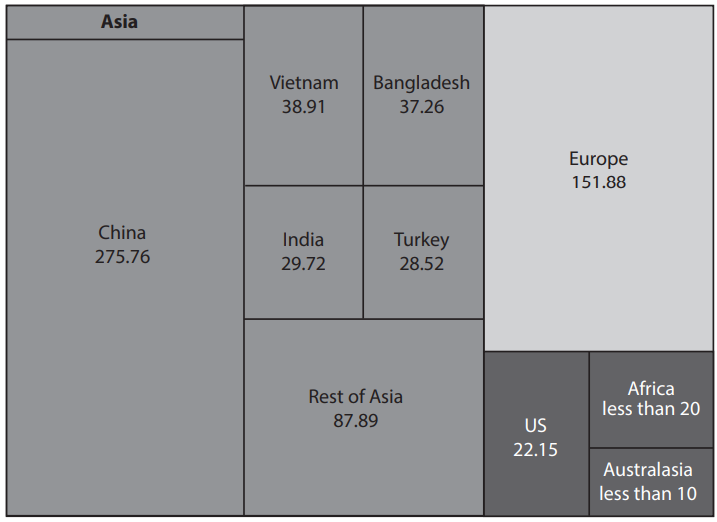
Value of textile exports in billions of US dollars, 2020

Treemap of 2020 textile exports in billions of dollars: China 275.76, Europe 151.88, rest of Asia 87.89, Vietnam 38.91, Bangladesh 37.26, India 29.72, Turkey 28.52, US 22.15; Africa under 20 and Australasia under 10.

(Source: adapted from OEC)

Previously clothing brands were attracted to China by a large labour force, low labour costs, clothing manufacturing technology, and high product quality. Factories concentrated in coastal port cities, also help with transportation. Fast-fashion brand Shein has its base in China.

Mango’s chief executive, Toni Ruiz, said he was considering buying less from China. “What we’re looking at is the extent to which all this global sourcing, developed over many years, might become more local,” he said.

According to China’s National Bureau of Statistics, the average factory wage doubled between 2013 and 2021. Products manufactured in China are not as competitive once shipping and transport costs are taken into account. An increasingly important consideration for retailers is traceability in the supply chain after years of widely reported labour abuses in China.

Many clothing brands are moving production to Turkey, which has a customs agreement with the European Union. Turkey also has a free trade agreement with the UK. Turkey has easy access to raw materials, such as cotton, as well as having a skilled workforce protected by strong labour laws. Hugo Boss and Zara already use Turkey as a production location.

(Source: adapted from https://www.ft.com/)

Assess whether the global clothing market could be considered a dynamic market.

1
20 marks

Read the following extracts (E to G) (opens in a new tab) before answering

Ebac's sales to mainland Europe have fallen by 55% since 2016. In order to remain competitive in the European market for white goods it is considering either relocating production facilities to Poland or reducing selling prices to match those of rivals such as Indesit and Hotpoint

Evaluate Ebac's options and recommend which one would be most appropriate to increase its European sales.

2
20 marks

Read the following extracts (D to G) (opens in a new tab) before answering

Taco Bell's objective in Brazil is to open 200 locations by 2027. It could achieve this growth either by selling franchises or by opening company-owned outlets

Evaluate these options and recommend which one is most likely to lead to Taco Bell's growth in Brazil.